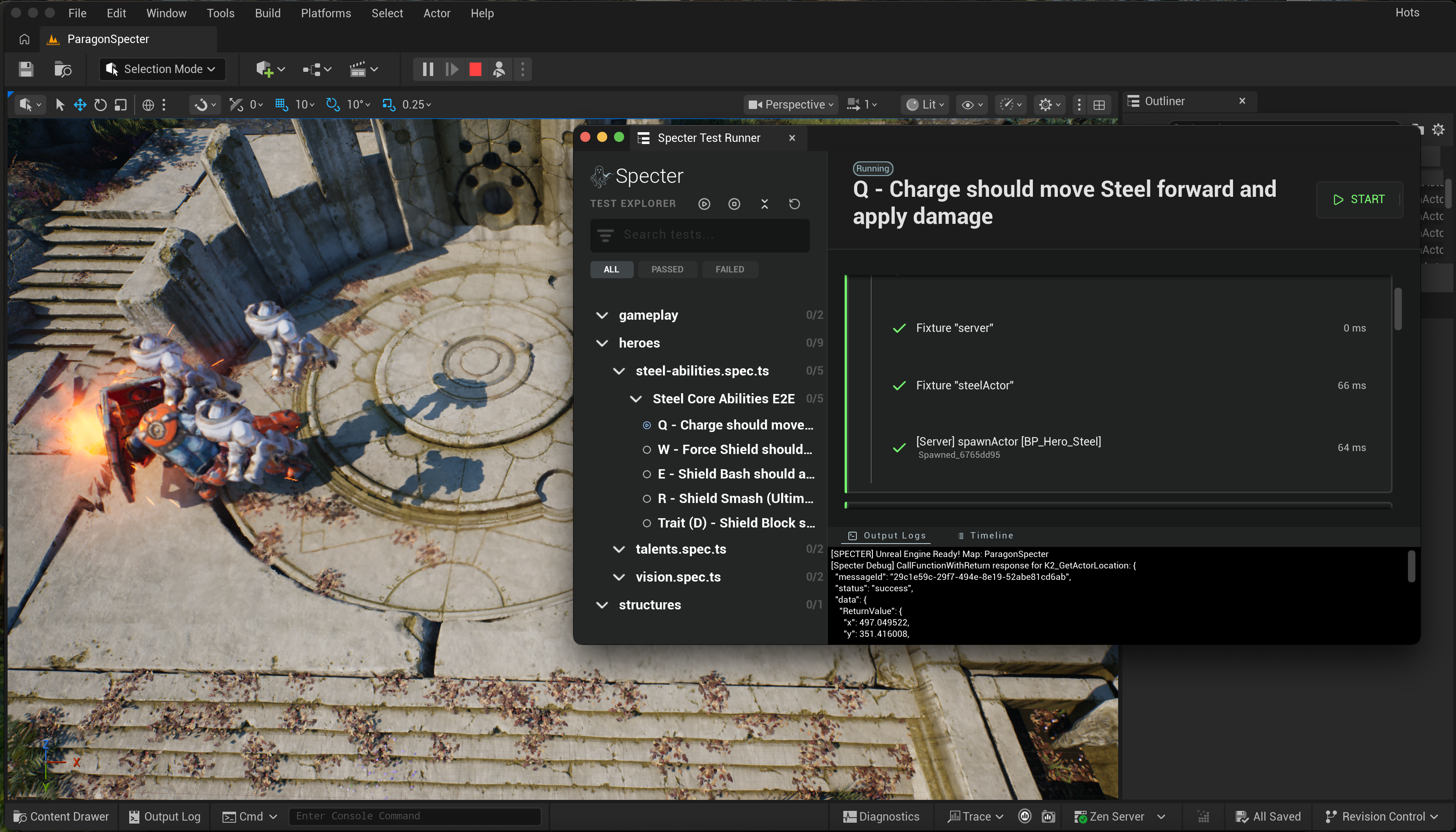
Enterprise-Grade Game Automation.
Modern Developer Experience.
Bring modern software testing practices directly into Unreal Engine. Specter bridges UE5 directly to Node via WebSockets, empowering your SDETs to build robust, code-driven test suites in TypeScript from day one.
Whether you are a native Unreal Engine developer, a web-standard SDET, or a manual QA tester transitioning to automation, Specter's readable TypeScript syntax eliminates the learning curve.
See It In Action
Watch how perfectly our Playwright game-object model syncs with native Unreal Engine execution.
import { test, expect } from '@specter-automation/test'

test("Q - Charge should move Steel forward and apply damage", async ({
    server: {
      heroes: { steel },
      minion,
    },
    steelActor,
  }) => {
    const enemySpawnLocations: Vector3[] = [
      { x: -412.950478, y: 441.416008, z: 160.0 },
      { x: -412.950478, y: 231.416008, z: 160.0 },
      { x: -582.950478, y: 301.416008, z: 160.0 },
    ];

    const enemies = await test.step("Spawn enemies", async () => {
      return await Promise.all(
        enemySpawnLocations.map((location) =>
          minion.spawn({
            theme: "paragon",
            type: "range",
            spawnOptions: {
              location,
              properties: { InitialTeamId: 2 },
              rotation: { pitch: 0, yaw: -90, roll: 0 },
            },
          }),
        ),
      );
    });

    const startLocation = await steelActor.getLocation();
    const forwardDirection = await steelActor.getForwardVector();
    await steelActor.triggerAbilityWithTarget(
      steel.abilityCharge,
      VectorUtils.addOffset(startLocation, forwardDirection, 50),
    );

    await test.step("Verify hit enemies recieve damage and knockback", async () => {
      await Promise.all([
        ...enemies.flatMap((enemy, index) => [
          expect(enemy).toHaveGameplayTag("Status.Stunned"),
          expect(enemy).toHaveAttributeChange("HealthSet", "Health", {
            delta: -100,
          }),
          expect(enemy).toHaveMovedFurtherThan(enemySpawnLocations[index], 100),
        ]),
      ]);
    });

    await expect(steelActor).toHaveMovedFurtherThan(startLocation, 1000);
  });
90% Less Boilerplate.
100% Native Execution.
Say goodbye to brittle, massive C++ test harnesses. Specter introduces the Game Object Model—giving your SDETs strongly-typed access to native actors and abilities directly from TypeScript.
import { WidgetLocator, SpecterWorld, SpawnOptions } from "@specter-automation/test";
import { HeroObject } from "./hero-object";

export class Steel extends HeroObject {
  public readonly talentJuggernautCharge: WidgetLocator;

  // Core Abilities
  public readonly abilityCharge: string; // Q
  public readonly abilityForceShield: string; // W
  public readonly abilityShieldBash: string; // E
  public readonly abilityShieldSmash: string; // R
  public readonly abilityShieldBlock: string; // Trait (D)

  constructor(readonly world: SpecterWorld) {
    super(world, "Hero.Steel");

    // Locators are exposed directly as properties to avoid boilerplate wrapper methods
    this.talentJuggernautCharge = world.widget(
      "Button_Talent_JuggernautCharge",
    );

    // Expose gameplay tags representing his abilities
    this.abilityCharge = "Ability.Slot.Q";
    this.abilityForceShield = "Ability.Slot.W";
    this.abilityShieldBash = "Ability.Slot.E";
    this.abilityShieldSmash = "Ability.Slot.R";
    this.abilityShieldBlock = "Ability.Slot.D";
  }

  async spawn(spawnOptions: SpawnOptions = {}) {
    spawnOptions.spawnController = true;
    return await this.world.spawnActor(
      "/Game/Blueprints/Units/Heroes/Steel/BP_Hero_Steel.BP_Hero_Steel",
      spawnOptions,
    );
  }
}
The Native Reality
For contrast, look at the code on the rightbelow. This is the exact same test written natively in Unreal's Gauntlet framework using C++.
Manual cast fetching, brittle latent command queuing, zero IntelliSense for objects... this is what costs studios millions of dollars in SDET velocity.
#include "Misc/AutomationTest.h"
#include "Tests/AutomationCommon.h"
#include "Engine/World.h"
#include "AbilitySystemGlobals.h"
#include "AbilitySystemComponent.h"
#include "HotsAttributeSet.h"
#include "GameFramework/Character.h"

// 1. Define the Spec and State Variables
BEGIN_DEFINE_SPEC(FSteelChargeSpec, "Game.Combat.SteelCharge", EAutomationTestFlags::ProductFilter | EAutomationTestFlags::ApplicationContextMask)
    ACharacter* SteelActor;
    TArray<ACharacter*> Enemies;
    TArray<FVector> EnemySpawnLocations;
    FVector SteelStartLocation;
    TArray<float> InitialEnemyHealths;
END_DEFINE_SPEC(FSteelChargeSpec)

void FSteelChargeSpec::Define()
{
    It("Q - Charge should move Steel forward and apply damage and stun to enemies", [this]()
    {
        UWorld* World = GEngine->GetWorldContexts()[0].World();
        if (!World) return false;

        // 2. Set Up Spawn Locations
        EnemySpawnLocations = {
            FVector(-412.95f, 441.41f, 160.0f),
            FVector(-412.95f, 231.41f, 160.0f),
            FVector(-582.95f, 301.41f, 160.0f)
        };

        // 3. Spawn Enemies and Record Initial State
        for (const FVector& SpawnLoc : EnemySpawnLocations)
        {
            // Note: Manual class fetching from Blueprint paths
            UClass* MinionClass = StaticLoadClass(ACharacter::StaticClass(), nullptr, TEXT("/Game/Blueprints/Units/Minions/Paragon/Range/BP_Paragon_Range_Minion.BP_Paragon_Range_Minion_C"));
            ACharacter* Minion = World->SpawnActor<ACharacter>(MinionClass, SpawnLoc, FRotator(0, -90, 0));

            // Note: Property overrides like TeamId require manual casting/setters in C++
            if (AMinionCharacter* MinionChar = Cast<AMinionCharacter>(Minion)) {
                MinionChar->TeamId = 2;
            }

            Enemies.Add(Minion);

            // Fetch ASC to read baseline health
            UAbilitySystemComponent* MinionASC = UAbilitySystemGlobals::GetAbilitySystemComponentFromActor(Minion);
            if (MinionASC) {
                bool bFoundHealth;
                float Health = MinionASC->GetNumericAttribute(UBaseAttributeSet::GetHealthAttribute(), bFoundHealth);
                InitialEnemyHealths.Add(Health);
            }
        }

        // 4. Calculate Target Vector
        SteelStartLocation = SteelActor->GetActorLocation();
        FVector ForwardDirection = SteelActor->GetActorForwardVector();
        FVector TargetLocation = SteelStartLocation + (ForwardDirection * 50.0f);

        // 5. Trigger the Ability via Gameplay Ability System
        UAbilitySystemComponent* SteelASC = UAbilitySystemGlobals::GetAbilitySystemComponentFromActor(SteelActor);
        if (SteelASC)
        {
            // Note: Targeting requires manually constructing GameplayEventData in C++
            FGameplayEventData Payload;
            Payload.TargetData = UAbilitySystemBlueprintLibrary::AbilityTargetDataFromLocations(
                FGameplayAbilityTargetingLocationInfo(),
                FGameplayAbilityTargetingLocationInfo() // Requires manual setup
            );

            FGameplayTag AbilityTag = FGameplayTag::RequestGameplayTag(FName("Ability.Charge"));
            SteelASC->HandleGameplayEvent(AbilityTag, &Payload);
        }

        // 6. Queue a Latent Command to allow physics/animations to tick
        ADD_LATENT_AUTOMATION_COMMAND(FEngineWaitLatentCommand(2.5f));

        // 7. Queue ANOTHER Latent Command lambda to execute the assertions
        ADD_LATENT_AUTOMATION_COMMAND(FFunctionLatentCommand([this]()
        {
            // Verify Steel's Movement
            float SteelDistance = FVector::Dist(SteelStartLocation, SteelActor->GetActorLocation());
            TestTrue(TEXT("Steel moved further than 1000 units"), SteelDistance > 1000.0f);

            // Verify Enemy States
            for (int32 i = 0; i < Enemies.Num(); ++i)
            {
                ACharacter* Enemy = Enemies[i];
                if (!Enemy) continue;

                UAbilitySystemComponent* EnemyASC = UAbilitySystemGlobals::GetAbilitySystemComponentFromActor(Enemy);
                if (!EnemyASC) continue;

                // Assert Tag
                FGameplayTag StunTag = FGameplayTag::RequestGameplayTag(FName("Status.Stunned"));
                TestTrue(TEXT("Enemy has Stunned tag"), EnemyASC->HasMatchingGameplayTag(StunTag));

                // Assert Attribute Change
                bool bFoundHealth;
                float CurrentHealth = EnemyASC->GetNumericAttribute(UBaseAttributeSet::GetHealthAttribute(), bFoundHealth);
                TestEqual(TEXT("Enemy took 100 damage"), CurrentHealth, InitialEnemyHealths[i] - 100.0f);

                // Assert Knockback
                float EnemyDistance = FVector::Dist(EnemySpawnLocations[i], Enemy->GetActorLocation());
                TestTrue(TEXT("Enemy was knocked back > 100 units"), EnemyDistance > 100.0f);
            }

            return true;
        }));

        return true;
    });
}import { test, expect } from '@specter-automation/test'
test("Q - Charge should move Steel forward and apply damage", async ({
server: {
heroes: { steel },
minion,
},
steelActor,
}) => {
const enemySpawnLocations: Vector3[] = [
{ x: -412.950478, y: 441.416008, z: 160.0 },
{ x: -412.950478, y: 231.416008, z: 160.0 },
{ x: -582.950478, y: 301.416008, z: 160.0 },
];
const enemies = await test.step("Spawn enemies", async () => {
return await Promise.all(
enemySpawnLocations.map((location) =>
minion.spawn({
theme: "paragon",
type: "range",
spawnOptions: {
location,
properties: { InitialTeamId: 2 },
rotation: { pitch: 0, yaw: -90, roll: 0 },
},
}),
),
);
});
const startLocation = await steelActor.getLocation();
const forwardDirection = await steelActor.getForwardVector();
await steelActor.triggerAbilityWithTarget(
steel.abilityCharge,
VectorUtils.addOffset(startLocation, forwardDirection, 50),
);
await test.step("Verify hit enemies recieve damage and knockback", async () => {
await Promise.all([
...enemies.flatMap((enemy, index) => [
expect(enemy).toHaveGameplayTag("Status.Stunned"),
expect(enemy).toHaveAttributeChange("HealthSet", "Health", {
delta: -100,
}),
expect(enemy).toHaveMovedFurtherThan(enemySpawnLocations[index], 100),
]),
]);
});
await expect(steelActor).toHaveMovedFurtherThan(startLocation, 1000);
});In-Engine Test Explorer & Playwright UI
No context switching. Specter includes a native Unreal Editor Utility Widget that embeds the Playwright test runner directly inside UE5. Run test suites, stream live frame telemetry, and debug step failures without ever leaving the editor.